
Shocking Grace
Jesus' encounters with two women

Luke 7 v. 36 – 8 v. 3 ‘Jesus said to Simon, do you see this woman?’
The guests are all assembled, with Jesus as the most honoured of them all. Simon the Pharisee considers it a great achievement to have the crowd-pleasing young preacher at his table. The wine is flowing, the conversation is lively, the room is buzzing. But soon this convivial banquet is unexpectedly disrupted. A woman – and not just any woman, but a known woman of, shall we say, dubious reputation – comes barging in, without so much as a knock at the door, and flings herself upon Jesus. A dumbfounded silence ensues, before the eruption of a cacophony of indignant, scandalized voices.
Table manners are very important in the ancient world. The etiquette of hospitality, of table fellowship, marks out the boundaries of who is in and who is out, of acceptable and unacceptable behaviour. This is the story of a gross violation of hospitality, a breach of table manners. But wait: who is it that is actually guilty of committing the violation?
The woman’s action is shocking, sensual, even erotic in its intensity and its breach of the boundaries. Simon, the host, is disoriented and dismayed by it. Here he is, welcoming to his table the young rabbi with all his star quality, and now the calm of his urbane dinner party is rudely shattered by the woman’s abrupt entrance and unseemly display of raw emotion. Simon is nonplussed, but manages to button his lip and keep his negative judgments to himself. But Jesus is not fooled: and a deeply uncomfortable interrogation follows about who loves the most. Simon would rather be somewhere else – anywhere else.
At length Jesus speaks. ‘Do you see this woman?’ What then did Simon see? He saw a disreputable person. He saw a disgraceful transgression of table manners. He saw the plan of a pleasant, civilised evening ruined. He saw a rising young star rabbi being touched by an untouchable. He saw a shameful, humiliating, disastrous scene unfolding. But he did not see a sinner being saved by grace and full of love. This is what Jesus saw.
So who committed the violation? Jesus’ verdict is pretty devastating. ‘You did not give me a kiss ... you did not give me any water ... you did not put oil on my head.’ The woman’s table manners are far better than Simon’s, for she has done all these things, out of the generosity that flows from the sinfulness that can only turn to Jesus for forgiveness.
She is real: authentic, human, while Simon is all buttoned-up, cool and prejudiced: he does not ‘see’ her at all, not as one like himself, both of them weak, sinful and in need of grace. Before the time, she has already borne witness in her actions to the truth of St Paul’s words: she can only live ‘by faith in the Son of God who loved her and gave himself for her’. And this is how people blossom in generosity and love: not through moral uprightness, but through knowing forgiveness; not by rule-keeping, but in the human warmth that is the product of sheer gratitude.
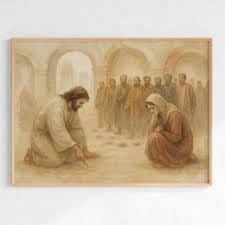
John 8 vv. 1–11 ‘If any one of you is without sin, let him be the first to cast a stone’
It is early morning, the play of light on courtyard stones, long shadows, a moment of anticipation. The Teacher, seated, ready to begin. There is a hush, it feels holy.
Over by the covered walkway, an unseemly disturbance. All eyes turn to look. Lawyers and Pharisees, in their robes and tassels and airs of self-importance, bustling in and bundling their captive. She looks trapped and tired and terrified. This woman. This nobody. Never mind the Teacher was ready to teach: this woman, this trophy of the moral police, had to come first.
‘Caught – caught in the act – in the very act – of adultery!’ Their pride in their achievement knew no bounds. What planning, what cunning, what invasion of privacy, what prying, unsavoury surveillance must it have taken to catch her in the act! They turn to Jesus, confident that so notable a young teacher will look with approval on their cause. ‘In the law Moses commanded us to stone such women. Now, what do you say?’
That curt phrase captures in its brevity such scorn, such despising: ‘such women’. ‘Such women’ are clearly a ‘them’ who are most definitely not ‘us’. ‘Such women’ are just the wretched types for whom ‘the Law’ was made, to weed them out from respectable society. How fortunate that the Teacher is here, just at the right moment, to ensure that justice takes its course.
‘But Jesus bent down and started to write on the ground with his finger.’ Gripping the woman tightly (though she looked too exhausted for any attempt at escape), the dignitaries gape at the Teacher: what on earth did he think he was playing at? He was ruining their big moment with his maddening silence and his stupid doodling in the sand.
‘It’s people like this woman who are lowering the moral tone of society. It’s people like this who are setting a bad example to our young. It’s people like this who are to blame for declining standards. She should be made an example of. A bit of strong medicine to warn others. Get a bit of discipline back into society…’ They trailed off. The Teacher looked up.
‘If any one of you is without sin, let him be the first to cast a stone.’ That was all; then, more silent writing. The writing on the ground. The writing on the wall: the judgment. A frisson went round the courtyard. The crowd shifting nervously on the hard stones, which suddenly felt sharp and uncomfortable. A chilly early morning breeze ruffled cloaks and a pale sunlight flickered over ghostly faces. The air felt strangely thin. A moment of awe, unsettling, disturbing. And what people felt was their guilt. Guilty of conspiring in the scapegoating plot of self-righteousness: finding a convenient somebody – a nobody – to blame for the ills the rest of us suffer from but don’t commit. Guilty of thinking, if we can just rid ourselves of this one, the rest of us will be able to live our complacent little lives in peace.
And so, quietly, one by one, one by one, they shuffle off like dogs with their tails between their legs. The Teacher remains, and the woman, rooted to the spot. ‘So: you and me! Where are they all? Has no-one condemned you?’
A tiny whisper, a wisp of a voice: ‘No-one, sir’.
‘Then neither do I condemn you. Go: and sin no more’.
The spell is broken. There is a release … the thirst for sacred retribution is gone. A new world is born, no longer based on scapegoating, moral superiority and punitive desire, but on compassion and forgiveness. That’s the only way we can all be healed. That’s what the Man from Nazareth has to teach us. Often, we still need to learn it.